
13 October 2026
The UK composite purchasing managers' index ("PMI"), a survey which tracks the health of the UK private-sector economy, eased to 52 in September from 52.5 in August, leaving activity growing but more slowly, and the British Retail Consortium put total footfall down 2.9% in the year to September from 1.7% in August. Gilts moved against that softness, the yield rising 7 basis points to 5.44%, as the market priced the Middle East energy shock's inflationary effect and the fiscal risk ahead of Chancellor John Healey's 28 October budget. The Institute for Fiscal Studies argued that inflation, rather than the chancellor's headroom, is the central problem, since rising prices erode departmental budgets while lifting tax receipts.
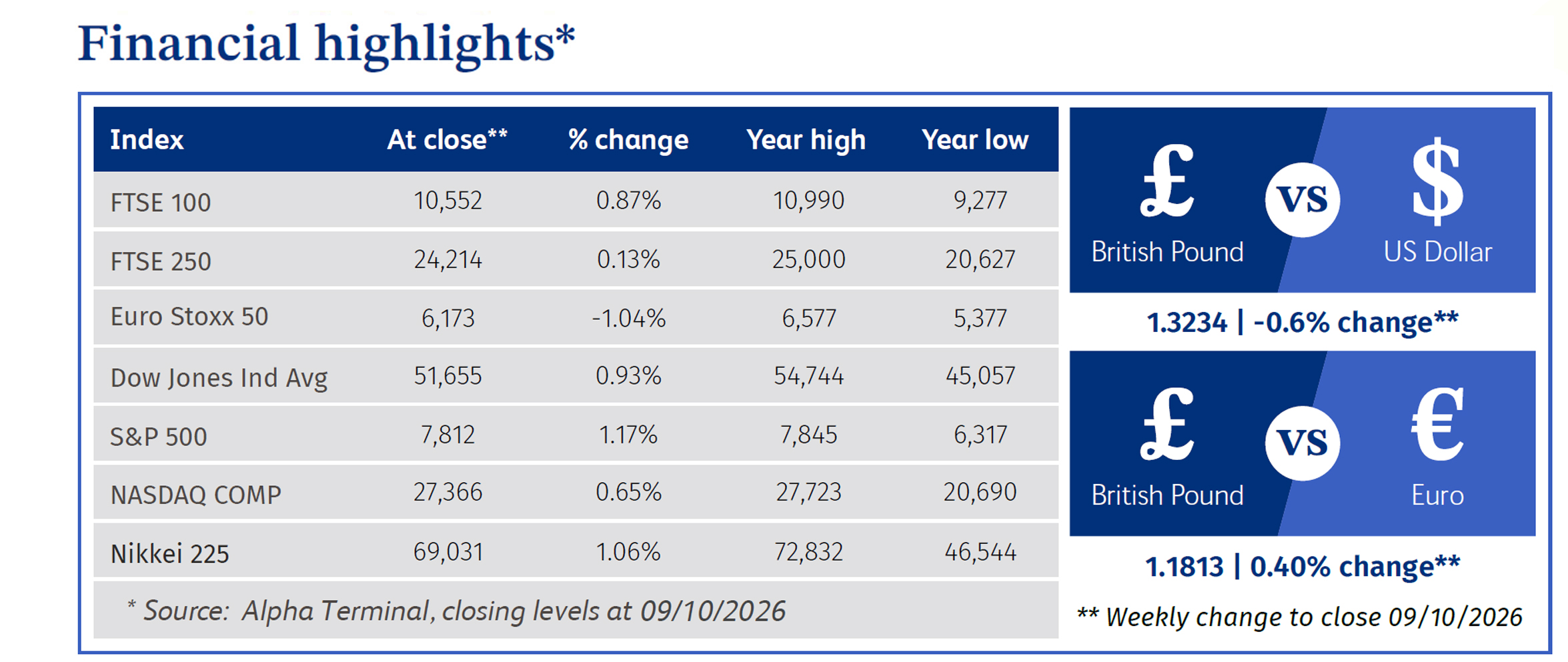
Oil set the tone for the UK market. Brent Crude held above $100 a barrel and briefly topped $105 on Thursday on reports of further tanker attacks in the Strait of Hormuz, before easing to $102.77 by Friday's London close after President Donald Trump ruled out attacking Iran before the November US midterm elections. The International Energy Agency ("IEA") capped the rise, confirming members had released 325 million of the 400 million barrels pledged in March, with more available. Energy was resilient on that backdrop, oil major Shell reporting an indicative third quarter refining margin of $42 a barrel against $24 in the second quarter, and the FTSE 100 rose while the smaller companies index was close to flat.
The same oil move fed into the US inflation picture. The Institute for Supply Management's services PMI eased to 54.9 in September from 55.4 in August, but its prices index climbed 1.4 points to 74, the highest since July 2022. Household expectations followed, the New York Federal Reserve putting year ahead inflation expectations at 3.9% in September from 3.6%, and the University of Michigan's October sentiment index at 46.3. September minutes, after the Federal Open Market Committee ("FOMC") voted 12 to 0 to raise the federal funds target range 25 basis points to 3.75% to 4%, showed most participants expected a further increase by year-end. Rising inflation expectations are hawkish and pull the next hike forward. Treasury yields fell with the 10-year ending at 5.24% from 5.27% after strong auctions, with consumer staples, utilities and energy leading US equities higher.
Minutes from the European Central Bank's ("ECB") September meeting, in which it announced its first rate rise since 2023, showed policymakers judged inflation risks to the upside and the energy shock's full effect still to come, without signalling whether more tightening follows. German factory orders fell 10.6% in the month of August and exports fell 0.8%, against industrial production up 2%. European equities fell, the hawkish policy backdrop and the Middle East tension weighing more heavily than that production rebound. Japanese equities gained while the fiscal picture stayed in focus. Japanese Prime Minister Sanae Takaichi pledged to control bond issuance, and her cabinet cut the consumption tax on food to 1% from 8% for two years from April 2027, without additional deficit bonds. The 10-year government bond yield fell to 3.01% from 3.08%. Nominal wages rose 3.8% in the year to August against 3.7% expected, but household spending fell 3.1%. The Nikkei 225 rose, led early by artificial intelligence ("AI") and semiconductor shares before investors questioned those valuations.
Experian, a global data and technology company supplying consumer credit reporting and scoring models, rose 9.16% over the week to stand at £26.82 per share. Market sentiment shifted positively as publishing and software stocks, previously hampered by fears of artificial intelligence disruption, experienced a broad sector-wide resurgence. The rally was further bolstered by the company's active share buyback programme; last week alone, Experian repurchased approximately 250,000 to 300,000 shares for cancellation. This continuous return of capital to shareholders signalled strong management confidence and helped sustain buying interest throughout the trading period.
Sage Group, a multinational enterprise software provider specialising in accounting, payroll, and human resources solutions, surged 8.96% over the week to stand at £10.71 per share. Mirroring Experian's trajectory, the stock benefited heavily as investors who had previously sold off technology shares decided to buy back into software companies. The positive market mood was underpinned by recent solid sales growth and management's decision to pay off €500 million of company debt early. This early debt repayment proved the firm has a very healthy cash position, reassuring shareholders and insulating the stock from broader economic uncertainty.
Barratt Redrow, the UK's largest housebuilder by volume following a recent merger, dropped 8.74% over the week to stand at 290.4 pence per share. Initially, investor confidence was bolstered following Prime Minister Andy Burnham's announcement of the new "Your First Home" scheme, allowing first-time buyers to purchase with just a 2.5% deposit. However, with the UK 30-year gilt yields surging past 6% for the first time since 1998, it sparked fears of rising mortgage costs and squeezed builder margins, leading to a large sell-off in the stock. Although management attempted to support the valuation by repurchasing 3.3 million shares, these broader economic fears caused a sharp pullback in the stock's valuation.

Market Commentary prepared by Walker Crips Investment Management Limited.
This publication is intended to be Walker Crips Investment Management's own commentary on markets. It is not investment research and should not be construed as an offer or solicitation to buy, sell or trade in any of the investments, sectors or asset classes mentioned. The value of any investment and the income arising from it is not guaranteed and can fall as well as rise, so that you may not get back the amount you originally invested. Past performance is not a reliable indicator of future results. Movements in exchange rates can have an adverse effect on the value, price or income of any non-sterling denominated investment. Nothing in this document constitutes advice to undertake a transaction, and if you require professional advice you should contact your financial adviser or your usual contact at Walker Crips. Walker Crips Investment Management Limited is authorised and regulated by the Financial Conduct Authority (FRN:226344) and is a member of the London Stock Exchange. Registered office: 128 Queen Victoria Street, London, EC4V 4BJ. Registered in England and Wales number 4774117.


Important Note
No news or research content is a recommendation to deal. It is important to remember that the value of investments and the income from them can go down as well as up, so you could get back less than you invest. If you have any doubts about the suitability of any investment for your circumstances, you should contact your financial advisor.

The value of investments can fall as well as rise. Investors may get back less than invested. Past performance is not a reliable indicator of future results.
The value of investments can fall as well as rise. Investors may get back less than invested.